


You’ve almost certainly seen them before—in a coffee shop, at a family gathering, or spread across a table in the school library. They are colorful cards featuring fantastic beasts and strange symbols, stared at with an intense focus that feels like a secret language. For millions around the globe, these aren’t just collectibles; they are armies of card game monsters battling for supremacy. If you’ve ever felt like an outsider looking in, wondering what makes these simple pieces of cardboard so captivating, you’ve come to the right place. Check out Daftar CINTA78 to know more
The secret to understanding these games isn’t about memorizing a thousand rules. The entire hobby boils down to a few core ideas, starting with the monster itself. Most of the strategy hinges on just two numbers you can find on almost any card—one telling you how hard it hits, and one showing how much damage it can take. Add in one simple concept that prevents players from using their strongest creature on the very first turn, and you already understand more than you think.
This guide will decode the world of trading card games (TCGs) by breaking down the anatomy of a monster card, explaining the simple rules of combat, and exploring how key differences give games like Pokémon, Yu-Gi-Oh!, and Magic: The Gathering their unique personalities. You won’t just see a collection of colorful cards; you’ll see the strategic engine running underneath, empowering you to follow a match and understand the appeal.
What Am I Looking At? Decoding the Anatomy of a Monster Card
At first glance, a monster card can seem like a confusing jumble of symbols and text. But once you know where to look, it’s surprisingly simple. The story of a monster—whether from the Pokémon TCG or another game—is often told through a few key numbers that define its place on the battlefield.
Think of a monster’s role in the game like a boxer’s stats. The two most important numbers are “Attack” and “Health.” A monster’s Attack is its punching power—the higher the number, the more damage it deals. Its Health, often shown as “HP” (Hit Points), is its stamina. This is the total damage it can take before being knocked out of play. A monster with high Attack and low HP is a “glass cannon”: strong, but fragile.
While high Attack and Health are crucial, you can’t play your strongest card right away. To keep games balanced, every card has a “Cost” you must pay to use it. Much like saving up for a big purchase, you need to gather special resource or “Energy” cards over several turns to afford a monster with a high cost.
By understanding just those three values—Attack, Health, and Cost—you can look at a card and know its basic story. Is it a cheap, quick attacker or a durable, late-game titan? These numbers provide the foundation, but the real fun begins when these creatures finally clash.
So They Fight? How Monster Card Combat Actually Works
Once you can size up a monster by its stats, it’s time to put them into action. Combat in these games isn’t a chaotic free-for-all; it’s a structured, turn-based showdown. On their turn, a player decides which of their monsters, if any, will go on the offensive. This is called “declaring an attacker.” It’s a commitment—sending a soldier from your defensive line into enemy territory for a single, focused strike.
The defending player then faces a crucial choice. They can let the attack through, or they can use one of their own monsters to “block” it. Placing a blocker in front of an attacker forces those two monsters to fight each other directly. This decision is the heart of card game strategy: do you sacrifice one of your creatures to protect your position, or do you save your forces for a counter-attack later on?

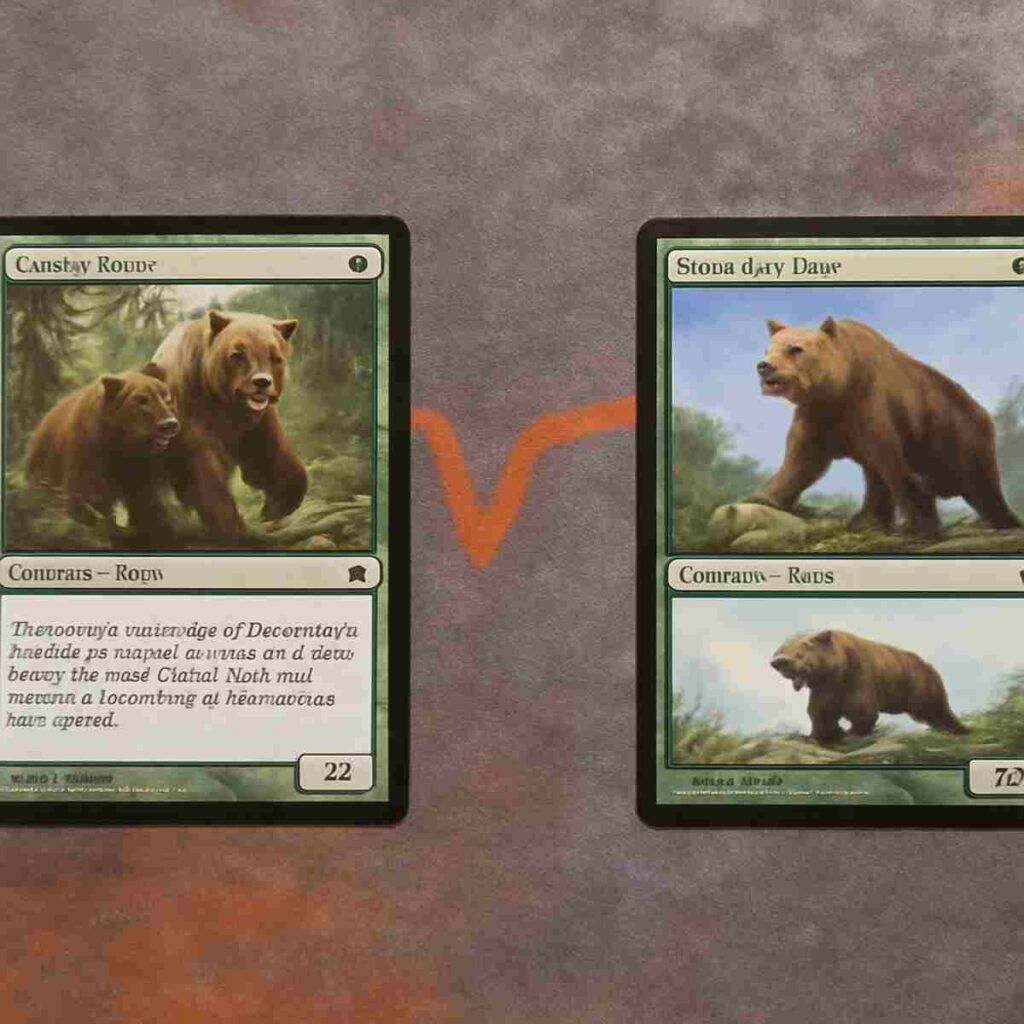
Once a block is declared, the two monsters deal damage to each other simultaneously using their Attack numbers. For instance, if a monster with 2 Attack fights another with 2 Attack, they each take 2 damage. If that damage is equal to or greater than a monster’s Health, it’s considered “defeated” or “destroyed” and is removed from play, usually going to a discard pile. In this case, both monsters would knock each other out in a simple trade.
This back-and-forth exchange forms the core of monster combat. It’s a puzzle where players constantly weigh the value of their creatures. Is it worth trading your small, fast monster to eliminate your opponent’s slow, powerful one? Recognizing this constant trade of resources is the key to understanding how the games are played.
Why Can’t I Just Play My Strongest Monster on Turn One?
If you have a powerful dragon in your hand at the start of the game, why not lead with your best asset? The answer lies in a simple, elegant rule found in most card games: you can’t afford it yet. Think of it like a personal budget. Each turn, you get a certain amount of currency to spend on your cards, and the most impressive items have the highest price tags. That “Cost” number we saw on the cards isn’t a suggestion; it’s a strict price you must pay to bring that monster into the game.
This “game budget” is managed by a resource system. While the specifics vary, the core idea is that you start with very few resources and gain more as the game progresses. In many popular games like Magic: The Gathering, this resource is called “Mana.” On your first turn, you might only have one Mana, enough to play a small squirrel or a lowly goblin. By your seventh turn, however, you could have seven Mana, finally giving you the power to summon that game-changing angel or fearsome demon.
This resource system is what makes a game feel like an epic journey instead of a five-second brawl. It ensures that both players have time to build their forces, creating a dramatic arc that starts with small skirmishes and builds toward a spectacular finish. It’s the engine that controls the game’s pacing, guaranteeing that when those colossal monsters finally hit the table, it feels like a truly momentous event.
The Beginner’s Guide to the Top Monster Card Games
With a grasp of the fundamental ideas—cost, attack, and health—you’re ready to see them in action. These concepts are the universal building blocks of nearly every monster card game. While the artwork, names, and worlds may seem wildly different, the core principles you’ve just learned are the secret keys to understanding what makes each one tick.
Let’s take a brief tour of the biggest names on the tabletop to see how they use these same ingredients to create unique experiences. Each one puts its own creative spin on what a monster can be and do, resulting in distinct personalities and strategies.
1. Pokémon TCG – The Power of Evolution
If there’s one game that perfectly captures the idea of a monster growing alongside you, it’s the Pokémon Trading Card Game. Many people are familiar with Pokémon evolving in the TV show or video games, and the card game turns that journey into its central mechanic. This focus on nurturing weaker creatures into powerful champions makes it one of the most intuitive card games for beginners. The goal isn’t just to win, but to see your chosen monster reach its full potential.
The core idea is simple: you can’t play your strongest monster right away. You have to build up to it over several turns. This process, called “Evolution,” creates a wonderful narrative of growth on the tabletop. A single monster’s power climb typically follows these steps:
- First, you play the small “Basic” Pokémon, like Charmander.
- On a later turn, you can place its “Stage 1” card, Charmeleon, directly on top of it.
- Finally, after another turn, you can place the powerful “Stage 2” card, Charizard, on the stack to complete the evolution.
This mechanic of staged evolution gives the game a slower, more deliberate pace. Each player is investing time and resources into building their team, creating exciting comeback moments when a long-awaited evolution finally hits the field. While Pokémon focuses on this gradual growth, other games prefer explosive speed.
2. Yu-Gi-Oh! – The Art of Summoning and Fusion
Where Pokémon emphasizes a slow, steady build-up, the Yu-Gi-Oh! A trading card game is all about explosive speed and powerful combinations. Instead of a single path to power like Evolution, Yu-Gi-Oh! gives players a huge toolbox of different ways to “summon”—it’s a term for putting a monster into play. This focus on creative, often complex summoning methods allows for dramatic turnarounds and a much faster-paced duel, where incredible beasts can appear on the very first turn.
One of its signature mechanics is “Tribute Summoning.” To play a truly mighty monster, you often can’t just pay a cost; you have to sacrifice monsters you already have on the field. Think of it like sacrificing a pawn in chess to bring out your queen. This creates a high-risk, high-reward system where players must decide if giving up their current board presence is worth the overwhelming power of a single, game-changing creature.
The game takes this concept even further with “Fusion Summoning,” which lets you combine specific monsters to create a completely new one. It works like a recipe: if you have “Monster A” and “Monster B” available, you can use a special card to fuse them into the mighty “Monster C.” This allows for some of the game’s most iconic moments, like combining three dragons into one colossal beast.
3. Magic: The Gathering – Where Creature Types Matter
In Magic: The Gathering, a creature’s identity is often just as important as its raw power. Below the name of nearly every creature is a “Creature Type”—a simple tag like “Elf,” “Goblin,” or “Zombie.” Think of it like building an army: you have your archers, your cavalry, and your foot soldiers, each belonging to a specific unit. This single line of text opens up a whole new layer of strategy that rewards teamwork over individual might.
This label isn’t just for show; it allows creatures to help each other out. A deck built around Goblins, for instance, might include a “Goblin Chieftain” card. This leader doesn’t just fight on its own; its special ability gives a bonus to every other Goblin you have in play. This focus on a single, cohesive “tribe” means that your strategy is about building a team, not just collecting a pile of unrelated heavy hitters.
The real magic happens when these bonuses take effect. That chieftain might grant all other Goblins a “+1/+1” bonus, a shorthand for giving each of them one extra point of Attack and one extra point of Health. Suddenly, your board of individually weak creatures becomes a powerful, coordinated force. This team-building aspect was revolutionary, a concept that digital card games like Hearthstone would later streamline for a new generation.
4. Hearthstone – Bringing Monster Cards to the Digital World
While games like Magic created the blueprint for monster teamwork, Blizzard Entertainment’s Hearthstone brought it to the screen in 2014. This blockbuster digital TCG simplifies the experience by having the computer handle all the rules. There’s no need to track Attack and Health with pen and paper or remember every bonus; the game does it all for you. This automation, combined with flashy animations and sound effects, made the genre of collectible card games more accessible to millions of new players.
Going digital also unlocked possibilities that simply can’t exist on a tabletop. Hearthstone introduced mechanics like “Discover,” where playing one card lets you choose a new one from a random selection of three. Think of it as the game suddenly dealing you a mini-hand of options tailored to the situation, pulled from a pool far larger than your own deck. This element of surprise and adaptation is a hallmark of the digital TCG experience, where the game itself can create cards out of thin air.
By removing the rulebook barrier and adding unique, computer-driven abilities, Hearthstone defined the modern digital card game. It proved that the strategic depth of monster collecting and battling could be delivered in a package that was vibrant, intuitive, and full of unexpected moments.
5-10. A Lightning Tour of Other Monster-Filled Worlds
With the foundations of monster stats and digital gameplay in mind, you can now see just how creative game designers get. The basic idea of summoning a creature to fight for you is just the starting point. Dozens of games have put their own exciting spin on monster combat, showing that there’s always a new way to build an army.
This sheer variety is a huge part of the hobby’s appeal. Here’s a quick look at how a few other popular games change the rules of monster battling:
- Gwent: The Witcher Card Game focuses on row-based combat. Like organizing an army into archers and infantry, where you place your monster on the battlefield is just as important as which monster you play.
- Flesh and Blood makes monsters hero-centric. Instead of summoning a team, your main hero is the focus, and monster cards often represent weapons or special attacks they personally use in a duel.
- Digimon Card Game introduces a raising area. You can play a baby monster in this safe zone, letting it “digivolve” and grow stronger over a few turns before it hatches and joins the fight.
- Cardfight!! Vanguard gives you a leader monster. One central creature acts as your general, leading the charge and often powering up your entire team.
- Legends of Runeterra lets you level up your champions. Special hero monsters can transform mid-game after meeting certain goals, unlocking devastating new abilities.
- Shadowverse uses Evolution for a mid-game power boost. For a limited number of times, you can give a monster a temporary but massive surge in strength to turn the tide.
From leading a legion to nurturing a single creature, each game offers a completely different fantasy. This constant innovation is a key reason why the world of monster cards is always expanding—and why some of those cards become so sought-after.
Why Are Some of These Cards Worth More Than a Car?
That “sought-after” quality isn’t just about a monster’s in-game power; it’s about its rarity. The secret lies in a concept called card rarity. When you buy a sealed booster pack—a small foil packet containing a handful of random cards—you aren’t guaranteed to get every monster. Instead, cards are printed in different quantities. “Common” cards appear in almost every pack, while the real prizes are the “Rare” cards, which are intentionally made difficult to find.
This system creates the thrill of the hunt, governed by what players call a pull rate. These are the statistical odds of finding a specific rare card inside a booster pack. For the most powerful monsters, the pull rate might be as low as one in a hundred packs. To make things even more exciting, manufacturers also print special, shiny versions of cards, often called foils or holographics. These shimmering variants are far scarcer than their regular counterparts, making them the ultimate treasure to “pull.”
Simple economics dictates the rest. Extreme scarcity, combined with high demand from players and collectors alike, is what can drive a card’s value from a few cents to thousands of dollars. The unbelievable odds are why finding one feels like winning the lottery, and why protecting valuable trading cards is such a critical part of the hobby.
The Three-Second Rule for Keeping Your Cards Safe
The moment you pull a rare card, a three-second rule kicks in for protecting it. Your first line of defense is the penny sleeve, a thin, soft plastic pocket. Think of it as a light jacket for your card, guarding against fingerprints and surface scuffs. It’s the absolute bare minimum for any card you care about.
For truly valuable monsters, however, a soft sleeve isn’t enough. That’s where the toploader comes in—a hard, rigid plastic case that prevents the card from bending or creasing. If the penny sleeve is a jacket, the toploader is a suit of armor for protecting cards from serious physical damage.
Crucially, these tools work together. You should always place your card inside a penny sleeve before sliding it into a rigid toploader. This two-step method ensures the hard plastic doesn’t scratch the card’s sensitive, holographic surface. This is the professional standard for keeping a cardboard treasure safe for years to come.
Finally, to keep your whole collection safe from harmful sunlight and humidity, collectors use specially designed card storage boxes. Unlike an old shoebox, these are made to fit protected cards perfectly, preventing them from rattling around and getting damaged.
Your Journey Into the TCG World Has Just Begun
What was once a piece of cardboard with confusing symbols now has a story. You can look at a monster card from a game like Pokémon or Magic: The Gathering and see a character with a purpose—understanding what it costs to play, how hard it can fight, and how much damage it can endure. You’ve learned the fundamental language spoken by millions of players, transforming you from a curious observer into a knowledgeable insider.
This newfound understanding is your starting point for exploring the hobby further. A fantastic, low-pressure next step is to search for a “learn to play” video of the game that seemed most interesting to you. Watching a short match connects the concepts of cost, combat, and abilities to the dynamic flow of a real game.
Ultimately, these cards are no longer a mystery. Each one is a strategic puzzle, a tiny hero, or a fearsome beast waiting for its moment on the battlefield. Whether you decide to pick up a deck one day or simply have a more engaging conversation with a fan of the hobby, you now see card game monsters not as a set of rules, but as what they truly are: a universe of imagination held in the palm of your hand.